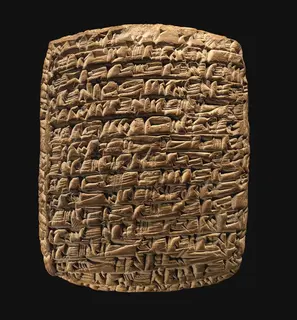

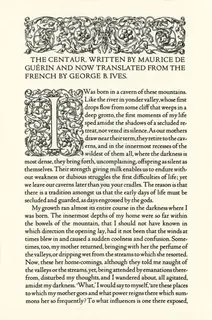
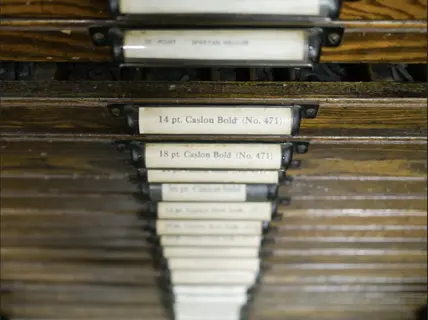
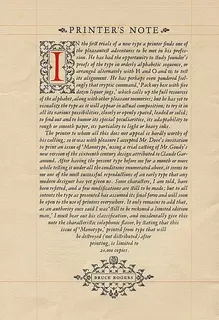
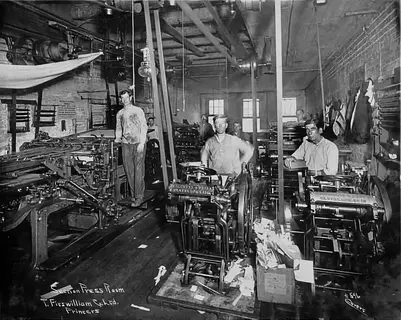
From the talk Books Are OG Protocols. Clay tablet, private letter, and Ryūryūkyo Shinsai, Man Seated With His Reading and Writing Materials before Him: The Metropolitan Museum of Art. Bruce Rogers, The Centaur (1915), via Greyweathers Press, and his Printer's Note, via Wikimedia Commons. Caslon drawers: photo by Rebecca Siegel. Press room, T. Fitzwilliam & Co., 1917: Wikimedia Commons.
The factory treats most of book production as protocol: decisions written down once and applied every time. This page collects what we read to think about that. It is a working shelf for anyone curious, and the source list for the studio's book on the protocols of books.
Entries follow The Chicago Manual of Style (18th ed.), notes-bibliography system, alphabetical within each section after Start here. Each has a line on why it's here.
Start here
One way in for each strand of this page: how a standard gets made, how habits become institutions, what a protocol is, and how a page helps you think.
-
Linscott, Gary. "How Machines Learned Precision: Accuracy from Iron in the Industrial Revolution." Gary Linscott (blog), October 1, 2026. https://glinscott.github.io/how-machines-learned-precision/.
How workshops made flat plates, true screws and millionth-of-an-inch measurement with no more accurate original to copy. The three-plate method is the clearest picture we know of a standard made by comparison alone, which is what a house style is. Its source list is a reading list of its own.
-
Berger, Peter L., and Thomas Luckmann. The Social Construction of Reality: A Treatise in the Sociology of Knowledge. Doubleday, 1966.
Habits harden into institutions, and people forget they made them. The sociology under every soft protocol: a style sheet is a habit someone wrote down. A short, generous introduction: Cool Tools Lab, "Book Freak #229: The Social Construction of Reality," Cool Tools, October 30, 2026, https://kk.org/cooltools/book-freak-229-the-social-construction-of-reality/.
-
Rao, Venkatesh, Tim Beiko, Danny Ryan, Josh Stark, Trent Van Epps, and Bastian Aue. "The Unreasonable Sufficiency of Protocols." Summer of Protocols, Ethereum Foundation, 2024. https://protocolized.io/resources/the-unreasonable-sufficiency-of-protocols.
The pilot study that started the Summer of Protocols: a working definition of protocol and ten ways a protocol can be "sufficient." The vocabulary the workshop borrows.
-
Allen, Roland. The Notebook: A History of Thinking on Paper. Profile Books, 2023. https://roland-allen.com/.
The notebook from the merchants' ledgers of fourteenth-century Florence to the Moleskine: thinking on a page you make yourself. Our book takes up the printed page someone else made, and the furniture that lets a reader think with it. Allen starts with double-entry bookkeeping, itself a protocol.
Soft protocols: conventions, institutions, standards
-
Alexander, Christopher, Sara Ishikawa, and Murray Silverstein, with Max Jacobson, Ingrid Fiksdahl-King, and Shlomo Angel. A Pattern Language: Towns, Buildings, Construction. Oxford University Press, 1977.
Two hundred fifty-three patterns for building, each written as a problem and its solution. Drew Austin's urban patterns borrow the form, and it is a good model for writing rules down.
-
Becker, Howard S. Art Worlds. 25th anniversary ed., updated and expanded. University of California Press, 2008.
Art as collective work, held together by conventions that everyone in the chain (printer, editor, critic, reader) relies on. Chapter 2, "Conventions," is the soft-protocol chapter.
-
Bowker, Geoffrey C., and Susan Leigh Star. Sorting Things Out: Classification and Its Consequences. MIT Press, 1999.
How categories and standards become invisible infrastructure, and who pays when they don't fit. Read before designing any controlled vocabulary.
-
Busch, Lawrence. Standards: Recipes for Reality. MIT Press, 2011.
Standards as technical, social and moral devices at once, and always layered. A good frame for the transmittal-stylesheet-preflight stack.
-
Carse, James P. Finite and Infinite Games. Free Press, 1986.
Games played to win and games played to keep playing. The last ProtocolKit mailer used it to explain why the binder never closes.
-
Galloway, Alexander R. Protocol: How Control Exists after Decentralization. MIT Press, 2004.
The critical counterweight: protocols distribute control rather than remove it. Useful for the cost side of "what should be protocolized."
-
Lindblom, Charles E. "The Science of 'Muddling Through.'" Public Administration Review 19, no. 2 (1959): 79–88.
Decisions made in small, comparable steps instead of from a master plan. One of the Protocol Institute's stated values draws on it, and so does the way a house style grows.
-
Polanyi, Michael. The Tacit Dimension. Doubleday, 1966.
"We can know more than we can tell." The classic account of tacit knowledge, the kind the production guilds carried and never wrote down.
-
Rao, Venkatesh. "Have Your Factory Call My Factory." Protocolized, March 2, 2026. https://protocolized.summerofprotocols.com/p/have-your-factory-call-my-factory.
Personal AI setups passing work to one another the way factories pass on intermediate goods, with domain knowledge counting for more than coding. The essay that named the studio's arrangement with Venkat's archive project.
-
Rao, Venkatesh. "In Search of Hardness." Contraptions (newsletter), December 16, 2023. https://contraptions.venkateshrao.com/p/in-search-of-hardness.
Protocols as engineered hardness, and the long argument over where protocols end and institutions, rituals and conventions begin.
-
Rao, Venkatesh, and Patrick Nast. "Theorizing Protocolization I: New Nature." Protocolized, January 8, 2026. https://protocolized.summerofprotocols.com/p/theorizing-protocolization-i-new.
The Protocol Institute's "New Nature": technologically mediated rules that feel as fixed as natural law. The symposium theme the workshop answers.
-
Stinson-Schroff, Timber. "Introducing the Protocol Institute." Protocolized. Accessed October 30, 2026. https://protocolized.summerofprotocols.com/p/introducing-the-protocol-institute.
The institute's mission and its case that protocol work is undervalued because success looks like nothing happening.
-
Yates, JoAnne, and Craig N. Murphy. Engineering Rules: Global Standard Setting since 1880. Johns Hopkins University Press, 2019.
The history of voluntary consensus standards, from screw threads to the web. Picks up where Whitworth leaves off.
The book as a social object
-
Chappell, Warren, and Robert Bringhurst. A Short History of the Printed Word. 2nd ed. Hartley & Marks, 1999.
Printing and type from the scribes to the computer, in one readable volume.
-
Darnton, Robert. "What Is the History of Books?" Daedalus 111, no. 3 (1982): 65–83.
The "communications circuit" from author through publisher, printer and bookseller to reader and back. The map of who touches a book.
-
Eisenstein, Elizabeth L. The Printing Press as an Agent of Change. 2 vols. Cambridge University Press, 1979.
The case that print changed how knowledge was made, kept and checked. Read with Johns, who argues that the change had to be built by people.
-
Gaskell, Philip. A New Introduction to Bibliography. Clarendon Press, 1972.
The standard account of how hand-press books were made: imposition, signatures, formats, the press room. Where the folded sheet is explained properly.
-
Genette, Gérard. Paratexts: Thresholds of Interpretation. Translated by Jane E. Lewin. Cambridge University Press, 1997.
Everything around the text that makes it a book: titles, dedications, epigraphs, prefaces, notes. Close to a catalog of what a transmittal decides.
-
Glaister, Geoffrey Ashall. Encyclopedia of the Book. 2nd ed. Oak Knoll Press; British Library, 1996.
A dictionary of the book trades, from papermaking to binding. The quickest way to check a term.
-
Johns, Adrian. The Nature of the Book: Print and Knowledge in the Making. University of Chicago Press, 1998.
Print was not trusted on arrival; that trust was built, by people, over two centuries. The historical case behind "a finished book is the one thing the flood cannot counterfeit."
-
McKenzie, D. F. Bibliography and the Sociology of Texts. Cambridge University Press, 1999.
Form affects meaning: type, layout and format are part of what a text says. The argument for taking typesetting seriously.
-
Roberts, Colin H., and T. C. Skeat. The Birth of the Codex. Oxford University Press for the British Academy, 1983.
How and why the codex replaced the scroll. The source for the codex chapters.
Thinking on paper: memory, navigation, screens
How the page helps a reader remember and find their way, and what changes on a screen. Start with Allen, above.
-
Blair, Ann M. Too Much to Know: Managing Scholarly Information before the Modern Age. Yale University Press, 2010.
How early modern scholars coped with more books than anyone could read: notes, extracts, indexes and reference works. Print made the problem, and print made the tools.
-
Carruthers, Mary. The Book of Memory: A Study of Memory in Medieval Culture. 2nd ed. Cambridge University Press, 2008.
Medieval memory as a trained craft with its own layouts and techniques. Background for reading page furniture as a memory system.
-
Carruthers, Mary. The Craft of Thought: Meditation, Rhetoric, and the Making of Images, 400–1200. Cambridge University Press, 1998.
Monastic memory and the buildings it used. The source behind Aaron Z Lewis's "Four Doors."
-
Delgado, Pablo, Cristina Vargas, Rakefet Ackerman, and Ladislao Salmerón. "Don't Throw Away Your Printed Books: A Meta-analysis on the Effects of Reading Media on Reading Comprehension." Educational Research Review 25 (2018): 23–38. https://doi.org/10.1016/j.edurev.2018.09.003.
Fifty-four studies and about 171,000 readers. A small advantage for paper with informational texts, larger when reading is timed, and growing over the years studied. No difference for narrative alone.
-
Duncan, Dennis. Index, A History of the: A Bookish Adventure from Medieval Manuscripts to the Digital Age. Allen Lane, 2021.
The index from medieval preachers' aids to search engines. The piece of page furniture built most directly for thinking with a book.
-
Mangen, Anne, Gérard Olivier, and Jean-Luc Velay. "Comparing Comprehension of a Long Text Read in Print Book and on Kindle: Where in the Text and When in the Story?" Frontiers in Psychology 10 (2019): 38. https://doi.org/10.3389/fpsyg.2019.00038.
Fifty readers, one 28-page story, half on a Kindle and half in a paperback. Most scores matched, but print readers were better at putting events in order, which the authors tie to the physical cues of a book.
-
Wolf, Maryanne. Reader, Come Home: The Reading Brain in a Digital World. Harper, 2018.
A reading researcher on what screen reading does to slow, deep reading. Read with Mangen and Delgado for the evidence.
Summer of Protocols and the Protocol Institute
The research program behind the workshop's vocabulary, and the institute that grew out of it. The studio produced ProtocolKit and The Protocol Reader. The essays, kit pieces and talks are in the Protocolized resource library: https://protocolized.io/resources.
-
Protocol Institute. "Core Values." Accessed November 2, 2026. https://protocol-institute.org/values/.
Ten values, from commons orientation and obliquity to subsidiarity and planetary thinking. How the institute means to work.
-
Summer of Protocols. The Protocol Reader. Summer of Protocols, 2025. https://protocolized.io/books/the-protocol-reader.
Twenty-six essays by thirty-one authors from the first program, sequenced as an introduction to protocol studies. Production editing and layout by Jenna Dixon.
-
Summer of Protocols. ProtocolKit. Summer of Protocols, 2023–24. https://protocolized.io/books/protocol-kit.
The 2023 research in print: six mailings, more than four hundred pages, filed in a three-ring binder. A book that isn't a codex, with an ISBN and a printer's key on every insert. Production editor, Jenna Dixon.
Essays in The Protocol Reader closest to this book
The Protocol Reader collected the substantive essays from ProtocolKit, so each of these appeared in both.
-
Alston, Eric, Seth Killian, and Garrette David. "Killswitch Protocols, or On Engineering Recursive System Death." https://protocolized.io/resources/killswitch-protocols.
Designing a system to be shut down.
-
Asparouhova, Nadia. "Dangerous Protocols." https://protocolized.io/resources/dangerous-protocols.
Protocols carry old tradeoffs into less visible forms, and the people inside them absorb the rules without noticing. The cost side.
-
Austin, Drew. "Protocols Don't Build Pyramids."
Coordination without a master plan.
-
Friend, Sarah. "Good Death." https://protocolized.io/resources/good-death-pdf.
Protocols for ending things: for books, out of print, rights reverted, formats nobody can open.
-
Hart, Chenoe. "Addressable Space." https://protocolized.io/resources/addressable-space-pdf.
How addresses organize space. Read for the addresses inside a book: page numbers, signature marks, citations.
-
Huang, Saffron. "Control and Consciousness of Time." https://protocolized.io/resources/control-and-consciousness-of-time.
Protocols as ways of keeping time.
-
Kittel, Kara, and Toby Shorin. "Unprotocolized Knowledge." https://protocolized.io/resources/unprotocolized-knowledge.
What resists being written down, and what happens when someone tries. A revised version is also online.
-
Kreutler, Kei. "Artificial Memory and Orienting Infinity." https://protocolized.io/resources/artificial-memory-and-orienting-infinity-pdf.
Memory as orientation. The anchor essay of the kit's memory-and-time mailing.
-
Lang, David. "Standards Make the World." https://protocolized.io/resources/summer-of-protocols-research-lang.
Standard setting as iterative work, through open-source hardware. Pairs with the 1886 point system.
-
Noujaim, Alice. "The Death and the Death of Orkut." https://protocolized.io/resources/the-death-and-the-death-of-orkut.
What happens to people when a platform dies.
-
Powers, Steve. "Protocolized Economics." https://protocolized.io/resources/protocolized-economics.
Protocols and markets.
-
Stark, Josh. "Atoms, Institutions, Blockchains." https://protocolized.io/resources/atoms-institutions-blockchains.
What makes a rule hard to break. A companion to Rao on hardness.
-
Steiert, Olivia. "Protocols in (Emergency) Time." https://protocolized.io/resources/summer-of-protocols-research-steiert.
Protocols under time pressure.
-
Tay, Janna. "A Phenomenology of Protocols." https://protocolized.io/resources/a-phenomenology-of-protocols.
What a protocol feels like from the inside.
-
Taylor, Dorian. "Retrofitting the Web." https://protocolized.io/resources/retrofitting-the-web-pdf.
Link rot, and building information to age well.
-
Van Epps, Trent. "Capital and Enclosure in Software Commons: Linux and Ethereum." https://protocolized.io/resources/capital-and-enclosure-in-software-commons-linux-ethereum.
How open commons stay open. The link is to the talk; the essay is in the Reader.
-
Walch, Angela. "The Protocol System Experience." https://protocolized.io/resources/the-protocol-system-experience.
The roles people take on inside a protocol, from joining to leaving. The link is to the talk; the essay is in the Reader.
ProtocolKit pieces not in The Protocol Reader
The games, cards, comics, drawings and explainers that only the kit carried.
-
Austin, Drew. "A Protocol Pattern Language for Urban Space." https://protocolized.io/resources/protocol-pattern-language-for-urban-space-introduction.
Serialized patterns in Alexander's problem-and-solution form.
-
Chang, Spencer. "Weaving Memory: How to Make a Memory Pouch." https://protocolized.io/resources/weaving-memory.
A wearable memory device, with instructions.
-
Friend, Sarah. "Founding Memorabilia from the Order of Protocological Death." https://protocolized.io/resources/founding-memorabilia-from-the-order-of-protocological-death.
Design fiction to accompany "Good Death."
-
Gong, Shuya. "Exit to Protocol." https://protocolized.io/resources/exit-to-protocol.
A card game, boxed.
-
Hart, Chenoe. "Addressable Space: Appendix." https://protocolized.io/resources/addressable-space-appendix.
Serialized scenarios, printed in the kit as "Addressable Protocols," from mechanical floors in skyscrapers to the nearest coffee shop. Companion to "Addressable Space."
-
Havel, Mario, and Tim Beiko. "Protocol Foundations." https://protocolized.io/resources/protocol-foundations-001-cryptography.
A series of explainers: cryptography, addressing, hashing and zero-knowledge proofs. Hashing and signatures are what a checkable colophon would need.
-
Kim, Nahee. "Re-move."
A comic about memory and exposure.
-
Lang, David. "Bristlemouth: An Open Protocol for Marine Hardware." https://protocolized.io/resources/bristlemouth-an-open-protocol-for-marine-hardware.
A spec sheet for an open-standard underwater connector: parts that must mate, like type that must lock up.
-
Lewis, Aaron Z. "Four Doors: An Architectural Memory Protocol," and the New Time Machines missives. https://protocolized.io/resources/four-doors-an-architectural-memory-protocol.
A building used as a memory palace, after Carruthers.
-
Rao, Venkatesh. "The Clockless Clock Maze." https://protocolized.io/resources/the-clockless-clock-maze.
A maze for thinking about time in protocol environments.
-
Schroff, Timber, and Shuya Gong. "Self-Ensured." https://protocolized.io/resources/self-ensured-cards.
Exercise cards as a safety protocol.
-
Sinisterra, Laura. "Virtual Structures." https://protocolized.io/resources/virtual-structures.
Drawings and short texts on what makes a structure virtual.
-
Summer of Protocols. 2023 Retrospectus. https://protocolized.io/resources/2023-retrospectus.
A summary of every project in the first program.
-
Waqar, Mashal. "Protocol Party."
A board game of the roles people play inside protocols: maintainer, drifter, revealer, clinger, sufferer, outsider, heretic.
Hard protocols: markup, style sheets, formats
-
Coombs, James H., Allen H. Renear, and Steven J. DeRose. "Markup Systems and the Future of Scholarly Text Processing." Communications of the ACM 30, no. 11 (1987): 933–47. https://doi.org/10.1145/32206.32209.
There is no such thing as "no markup"; the only choice is what kind. The classic case for marking what a thing is rather than how it looks.
-
European Parliament and Council of the European Union. "Directive (EU) 2019/882 on the Accessibility Requirements for Products and Services." Official Journal of the European Union L 151 (June 7, 2019). https://eur-lex.europa.eu/eli/dir/2019/882/oj.
The European Accessibility Act. It has applied to ebooks sold in the EU since June 28, 2025, which turned a soft rule into a hard one.
-
Kirschenbaum, Matthew G. Track Changes: A Literary History of Word Processing. Belknap Press of Harvard University Press, 2016.
How writers came to the word processor, 1964–1984. Background for why manuscripts arrive as .docx, with direct formatting in them.
-
Lie, Håkon Wium. "Cascading Style Sheets." PhD diss., University of Oslo, 2005. https://wiumlie.no/2006/phd/.
The design of CSS, and a survey of style sheet languages before the web. Separation of structure and appearance, from the person who built it.
-
Shea, Dave. CSS Zen Garden. 2003–. https://www.csszengarden.com/.
One HTML file, hundreds of designs; only the style sheet changes. The thesis in one click.
-
W3C. EPUB 3.3. W3C Recommendation, January 13, 2026. https://www.w3.org/TR/epub-33/.
The ebook format the factory builds. A web standard since its first Recommendation in May 2023, with an accessibility specification alongside it.
-
W3C. EPUB Accessibility 1.1. W3C Recommendation, 2023. https://www.w3.org/TR/epub-a11y-11/.
What makes an ebook accessible, and how an ebook says so in its metadata.
Structured-document standards, for comparison with the factory's thirteen styles:
- DITA Open Toolkit. Accessed October 30, 2026. https://www.dita-ot.org/.
- DocBook. Accessed October 30, 2026. https://docbook.org/.
- JATS (Journal Article Tag Suite). National Library of Medicine. Accessed October 30, 2026. https://jats.nlm.nih.gov/.
House rules: style manuals and typography
-
Bringhurst, Robert. The Elements of Typographic Style. Version 4.0. Hartley & Marks, 2012.
The typographer's handbook, and itself a versioned rulebook.
-
British Standards Institution. BS 5261-2:2005, Copy Preparation and Proof Correction. BSI, 2005.
The British standard behind most proof-correction charts.
-
The Chicago Manual of Style. 18th ed. University of Chicago Press, 2024.
The editorial standard this page follows and the studio's stylesheet (§6) draws on. First published in 1906 as the typographical rules of one press.
-
International Organization for Standardization. ISO 5776:2016, Graphic Technology: Symbols for Text Correction. ISO, 2016.
The international standard for proof-correction marks: a symbol language shared by author, editor, compositor and proofreader.
-
Merriam-Webster.com Dictionary. Merriam-Webster. Accessed October 30, 2026. https://www.merriam-webster.com/.
The studio's spelling authority (first listing).
Identifiers and metadata: the book in the supply chain
-
EDItEUR. ONIX for Books. Release 3.1. Accessed October 30, 2026. https://www.editeur.org/.
The XML standard publishers use to describe a book to every store and library. A controlled vocabulary with code lists for nearly everything.
-
Library of Congress. "Library of Congress Subject Headings." Accessed October 30, 2026. https://id.loc.gov/authorities/subjects.html.
How a library names what a book is about.
-
Library of Congress. "MARC Standards." Accessed October 30, 2026. https://www.loc.gov/marc/.
The catalog record: a book as a record inside a library's protocol.
Conformance regimes elsewhere
From Field notes: systems that check submissions against a versioned rulebook, the way Inspect checks a manuscript.
-
American Bureau of Shipping. "Rules and Guides Archives." Accessed October 30, 2026. https://ww2.eagle.org/en/rules-and-resources/rules-and-guides/archives.html.
Superseded rulebook editions kept on file; a vessel is judged against the edition in force.
-
The Bluebook: A Uniform System of Citation. Accessed October 30, 2026. https://www.legalbluebook.com/.
A rulebook whose job is making references resolvable.
-
Federal Register. "Airworthiness Directives." Accessed October 30, 2026. https://www.federalregister.gov/documents/search?conditions%5Bterm%5D=airworthiness%20directives.
Numbered, must-close findings that supersede one another.
-
International Code Council. "ICC Digital Codes." Accessed October 30, 2026. https://codes.iccsafe.org/.
Building-code plan review: a permit set returned with code citations.
-
Nature. "Formatting Guide." Accessed October 30, 2026. https://www.nature.com/nature/for-authors/formatting-guide.
Formatting conformance before peer review starts.
-
Paris MoU on Port State Control. "Inspection Search." Accessed November 3, 2026. https://parismou.org/inspection-search/.
Coded deficiencies with an explicit status vocabulary: a public findings log.
-
SKYbrary. "Standard Phraseology." Accessed October 30, 2026. https://skybrary.aero/articles/standard-phraseology.
A spoken controlled vocabulary built so meaning survives noise.
-
SNOMED International. "SNOMED CT." Accessed October 30, 2026. https://www.snomed.org/.
Clinical terminology: you can say only what the codebook lets you say.
-
World Health Organization. "ICD-10 Version: 2019." Accessed October 30, 2026. https://icd.who.int/browse10/2019/en.
The disease classification Bowker and Star study.
Software conformance:
- Astral. "Ruff." Accessed October 30, 2026. https://docs.astral.sh/ruff/.
- ESLint. Accessed October 30, 2026. https://eslint.org/.
- Go Project. "gofmt." Accessed October 30, 2026. https://pkg.go.dev/cmd/gofmt.
- JSON Schema. Accessed October 30, 2026. https://json-schema.org/.
- OpenAI. "Structured Outputs." Accessed October 30, 2026. https://platform.openai.com/docs/guides/structured-outputs.
- Preston-Werner, Tom. "Semantic Versioning 2.0.0." Accessed October 30, 2026. https://semver.org/.
Precision and bootstrapping
-
Moore, Wayne R. Foundations of Mechanical Accuracy. Moore Special Tool Company, 1970.
The modern account of hand scraping and the three-plate method; cited by Linscott.
-
Roe, Joseph Wickham. English and American Tool Builders. Yale University Press, 1916. https://archive.org/details/englishandameri00roegoog.
The classic history of Maudslay, Whitworth and the machine-tool makers.
-
Whitworth, Joseph. "A Paper on Plane Metallic Surfaces or True Planes." 1840. In Miscellaneous Papers on Mechanical Subjects. 1858. https://en.wikisource.org/wiki/Miscellaneous_Papers_on_Mechanical_Subjects/A_Paper_on_Plane_Metallic_Surfaces_or_True_Planes.
The method published so every workshop could make its own standard.
-
Whitworth, Joseph. "A Paper on an Uniform System of Screw Threads." 1841. In Miscellaneous Papers on Mechanical Subjects. 1858. https://en.wikisource.org/wiki/Miscellaneous_Papers_on_Mechanical_Subjects/A_Paper_on_an_Uniform_System_of_Screw_Threads.
An early national standard, proposed by one shop and adopted by an industry.
The book now
Sources for Why a book, now?.
-
Authors Guild. "Human Authored." Accessed October 30, 2026. https://authorsguild.org/human-authored/.
A one-bit, self-attested seal for human-written books.
-
Publishers Weekly. "Bookbuilders of Boston to Shutter Operations." News brief, May 2, 2022. https://www.publishersweekly.com/pw/newsbrief/index.html?record=3734.
The production trade's Boston organization, founded in 1937, closes for lack of interest after the pandemic; New York's guild had closed the year before.
-
deLone, Sean. "The Nonfiction Book Market Is Collapsing." Dear Head of Mine, September 8, 2026. https://dearheadofmine.substack.com/p/the-nonfiction-book-market-is-collapsing.
Reads the shift from nonfiction to fiction as a crisis of trust in authority.
-
Horowitch, Rose. "The End of Reading Is Here." Atlantic, August 2026. Published online July 8, 2026. https://www.theatlantic.com/magazine/2026/08/reading-crisis-postliterate-age/687618/.
The "postliterate" cover story; read with its rebuttals.
-
Milliot, Jim. "Book Output Topped Four Million in 2025." Publishers Weekly, March 17, 2026. https://www.publishersweekly.com/pw/by-topic/industry-news/publisher-news/article/99943-book-output-topped-4-million-in-2025.html.
Bowker's ISBN counts: 4.17 million US titles, 3.5 million self-published.
-
Publishers Weekly. "Authors Guild Opens Human Authored Certification to All U.S. Authors and Publishers." March 4, 2026. https://www.publishersweekly.com/pw/by-topic/industry-news/publisher-news/article/99836-authors-guild-opens-human-authored-certification-to-all-u-s-authors-and-publishers.html.
The seal's expansion, with first-year numbers.
Tools the factory runs on
-
Lua. Accessed October 30, 2026. https://www.lua.org/about.html.
-
MacFarlane, John. Pandoc. Accessed October 30, 2026. https://pandoc.org/.
-
python-docx. Accessed October 30, 2026. https://python-docx.readthedocs.io/.
-
Sloan, Robin. "'Ask for What You Want' Is a Key Skill for the 21st Century." September 18, 2026. https://www.robinsloan.com/lab/ask-for-what-you-want/.
Building your own software by describing it to an agent, which is how the factory was built.
-
Sloan, Robin. "An App Can Be a Home-Cooked Meal." February 2020. https://www.robinsloan.com/notes/home-cooked-app/.
Software made for one household. The factory started that way, then took outside clients, because the book trade has always worked factory to factory.
-
Typst. Accessed October 30, 2026. https://typst.app/.
From the studio
- Field notes: Language as protocol
- Why a book, now?
- House editorial stylesheet
- Lit-mag tool stack: 132 small magazines
- Book as Protocol Stack: Building a Protocolized Book Production Factory (talk, 2026 Protocol Symposium)
Suggest a source? Write to jenna@jdbb.net with the link and a line on why it belongs.